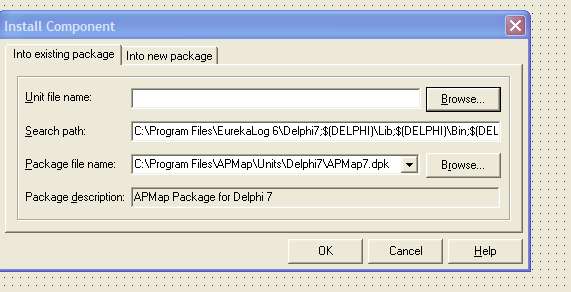
Installing components under Delphi XE3 is a nightmare. First I need to add source files to Tools - Options - Library. then I need to find a normal package and compile it. finally I need to find design time package and install it. This is just quite tedious and error prone. Is there a nicer way to install components?
A package source file should be saved with the.dpk (Delphi package) extension to avoid confusion with other files containing Del source code. To open a package source file in the Code editor, 1 Open the package in the Package editor.
I have found. Unfortunately it doesn't support Delphi XE3 or above. I have heard that there is something similar which produces exe packages that install themselves (something like Inno Setup) but I can't find such thing. The steps above are required. First, adding the file path to Tools-Options-Delphi Options-Library Path is so the compiler knows where to find the files to compile them. (Actually, it's not required - you can eliminate this step by making sure that the.dpk files are in the same folder as the.pas files, and that all.pas file names are listed in the includes section in the.dpk. If the.pas files are in a different location, you'll need to either use relative paths in the.dpk (eg., MyComponents in '.
Source MyComponents.pas') or add the location of the.pas files to Project-Options-Delphi Compiler-Search Path.) The next step (finding the 'normal package') is in order to build the runtime package. It's required, because the design-time package (next step) requires the code that's in that package in order to function in the Form Designer. It's also needed when you decide to build your application with runtime packages, if you use the third-party components and want to distribute the runtime package for it. The separate design-time package (the third step) is required because designtime code can only be used at design-time; there's nothing that can be distributed with an application if it's built with runtime packages and the package build in step 2 is one of them. This has been the way components are installed since around Delphi 3 or so, and the requirement to separate out designtime code into it's own package started being advised in Delphi 5 and enforced in Delphi 6 (when they relocated much of the IDE designtime support into their own separate packages and stopped distributing the source for them). There really are no other options, unless the vendor supplies pre-build designtime and runtime packages for you, or supplies an installer that will do all of the above steps.
(Most don't.) But if you update your Delphi version, you'd still have to go through the steps above. I would say that the best way to install components is to use your build manager (for example FinalBuilder) and add each component to a manager-project file which sets the necessary paths, builds the DPK files, and 'installs' the component in the IDE by making a registry entry.
Delphi Install Dpk Package In Pakistan
That way you have a documented procedure which allows you reliably to set up or repair your complete, tested, Delphi development environment. You can simply re-run the project when a component has been updated and tested.
It is also quite easy to tweak an existing project to handle a new Delphi version. The big disadvantage of a vendor-supplied installer is that all the ones I have seen simply overwrite the previous version on updates.
I prefer to control the install myself, so that I have previous component source versions archived and available for comparison, in case testing reveals a problem with an upgrade. The 'one-click install' sounds fine, until a minor component upgrade suddenly causes your application to stop working.
. Installing TMS components with shared units Background Several TMS Components share units. Two such examples are: ADVSTYLEIF.PAS and ADVGDIP.PAS. These units define commonly used functionality, classes, constants etc.

It is a known limitation of the Delphi packages architecture that for installed packages in the IDE, a unit can only be present in one package. As such, it is problematic to install two or more packages that use the same unit(s). It is not desirable at all from our development perspective and not from a deployment perspective to duplicate the code in units with different names.
Not only causes this issues when common constants, classes need to be used, but duplicating code is never a good idea. When multiple packages were purchased that have shared units, fortunatily as we deliver all products with full source code, it is straightforward to overcome this. When purchasing product bundles like this problem also does not occur. TMS Component Pack packages are designed & optimized to allow to use all components simultanously. Although it is more convenient to install & use a product like we did not want to remove the flexibility & freedom of customers to choose just some specific components instead of a bundle.
Step by step solution guide. Create a new folder. Move the shared unit(s) from the different product folders to the new folder (for example ADVSTYLEIF.PAS, ADVGDIP.PAS.). Open the package files of the different products and remove references to the shared unit(s) (for example ADVSTYLEIF.PAS, ADVGDIP.PAS.).
In the new folder, create a new package file: TMSCOMMON.DPK. Add the shared units to this new package file and compile & install this package TMSCOMMON.DPK. Open the package files of the different products and in the Requires list of the package, add a reference to TMSCOMMON.DCP. Compile & install the packages of the different products Now all products using the shared units will be installed. Example to illustrate the process When trying to install TAdvStringGrid and THTMListBox simultanously, the IDE will complain about shared units ADVSTYLEIF.PAS and ADVGRADIENT.PAS.
To install both components simultanously in Delphi 2010 we perform following steps: 1) Create new folder C: Users UserName tmssoftware TMSCommon, further referred to as ($CMN). 2) Move the files ADVSTYLEIF.PAS & ADVGRADIENT.PAS from the TAdvStringGrid folder to this ($CMN) folder. 3) Delete the files ADVSTYLEIF.PAS & ADVGRADIENT.PAS in the THTMListBox install folder.